
Facade Market Size
| Study Period | 2019 – 2030 |
| Market Size (2025) | USD 258.66 Billion |
| Market Size (2030) | USD 330.12 Billion |
| CAGR (2025 – 2030) | 5.00 % |
| Fastest Growing Market | North America |
| Largest Market | Asia-Pacific |
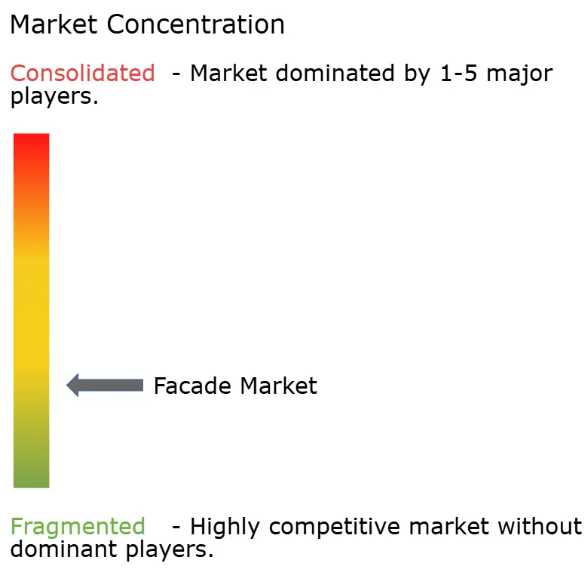
| Market Concentration | Low |
Major Players
*Disclaimer: Major Players sorted in no particular order |
Facade Market Analysis
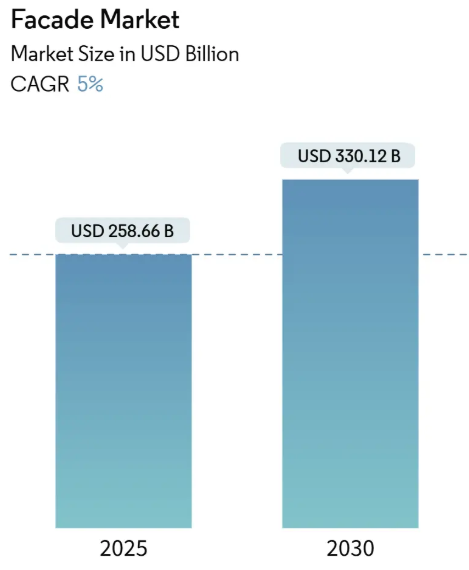
The Facade Market size is estimated at USD 258.66 billion in 2025, and is expected to reach USD 330.12 billion by 2030, at a CAGR of 5% during the forecast period (2025-2030).
Urbanization, technological advancements, and a growing emphasis on sustainability are driving robust growth in the global facade market. The increasing demand for energy-efficient and visually appealing building designs is a key factor contributing to the expansion of the facade industry. Additionally, stringent regulations advocating for sustainable construction practices are further boosting the facade market size.
The facade industry share is growing as green building initiatives gain momentum and advanced materials enhance energy efficiency. Modern facades are designed to maximize natural light and optimize thermal performance, with features like ventilated facades becoming increasingly popular. Rising investments in contemporary architectural designs that merge functionality with aesthetics are solidifying the role of facades as essential elements for architects and developers. North America and Europe are leading the global facade market, leveraging strong regulatory frameworks and sustainability commitments to drive innovation in advanced facade systems.
Meanwhile, the Asia Pacific facade market size is experiencing rapid growth, fueled by urbanization and infrastructure expansion in countries like China and India. The rising demand for high-performance building envelopes in these nations is accelerating the facade market’s expansion. As global markets increasingly prioritize sustainability and technology-driven solutions, the facade industry is poised for continued growth, offering extensive opportunities for stakeholders in construction and real estate.
Facade Market Trends
Commercial Sector is Driving the Facades Installation
- The facade industry is witnessing strong growth, driven by the increasing development of commercial buildings and office spaces with a focus on energy efficiency. Over the coming years, higher investments in the renovation of aging office buildings are expected to significantly boost the facade market size. Additionally, the rising demand for aesthetically appealing commercial structures is fueling the expansion of the facade market, particularly in major urban centers.
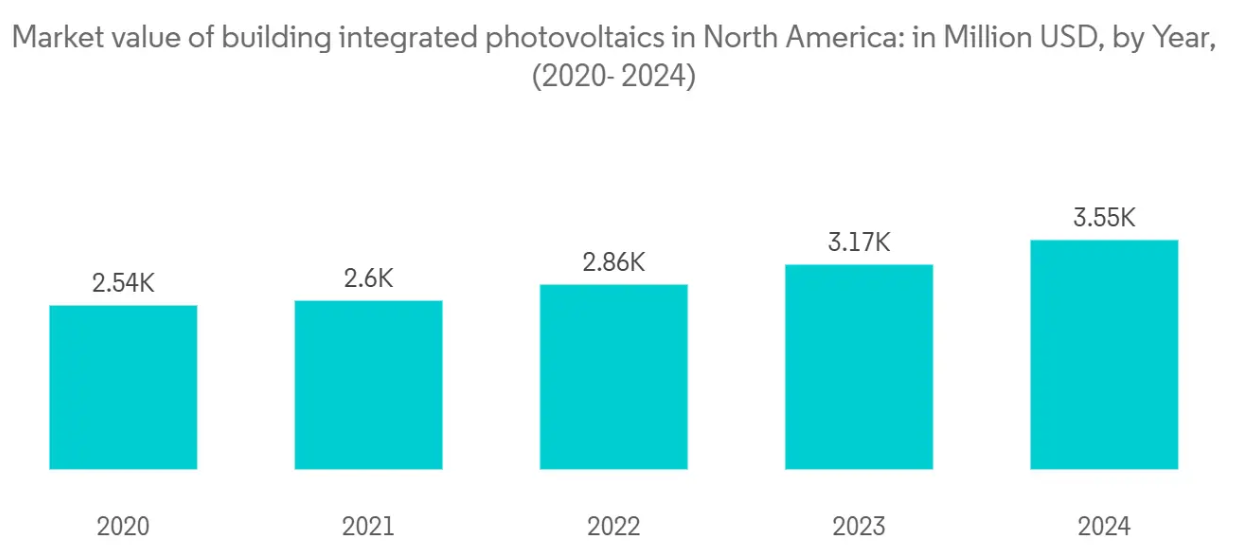
- Despite economic slowdowns, the commercial and industrial sectors have shown remarkable resilience, further driving facade industry share. In North America, the United States construction sector has outpaced Canada and Mexico over the past 18 months, contributing to the region’s facade market growth. The construction of large-scale commercial projects, such as the Keystone Trade Center and the Eight Office Tower in Bellevue, Washington—spanning 50,167 square meters with a 25-story office tower—demonstrates the increasing demand for facade installations in the North American market.
- Similarly, the European facade market size is expanding as commercial sector investments drive new construction and renovation projects. European nations are prioritizing energy-efficient facade solutions in commercial developments, leading to greater demand for high-performance building envelopes. The ongoing modernization of office spaces and a growing emphasis on architectural aesthetics are key factors propelling the facade market share in the region.
Asia-Pacific is Witnessing Significant Growth in the Market
- The Asia-Pacific facade market is experiencing substantial growth, driven by increasing construction activity and a strong emphasis on enhancing external aesthetics and energy efficiency. This rising demand has positioned the region’s facade industry as a key player in global market expansion. Rapid urbanization in India, Japan, and China is further accelerating the adoption of facades, with innovative architectural developments underscoring this trend.
- A prime example is China’s Dance of Light skyscraper, a 180-meter-tall structure featuring one of the world’s most intricate facade designs, showcasing Asia-Pacific’s commitment to advanced facade industry solutions. China and India are leading the Asia-Pacific facade market share, fueled by rapid urbanization and large-scale infrastructure projects. As cities expand and prioritize sustainability, the demand for high-performance building envelopes continues to surge, further strengthening the Asia-Pacific facade market size.
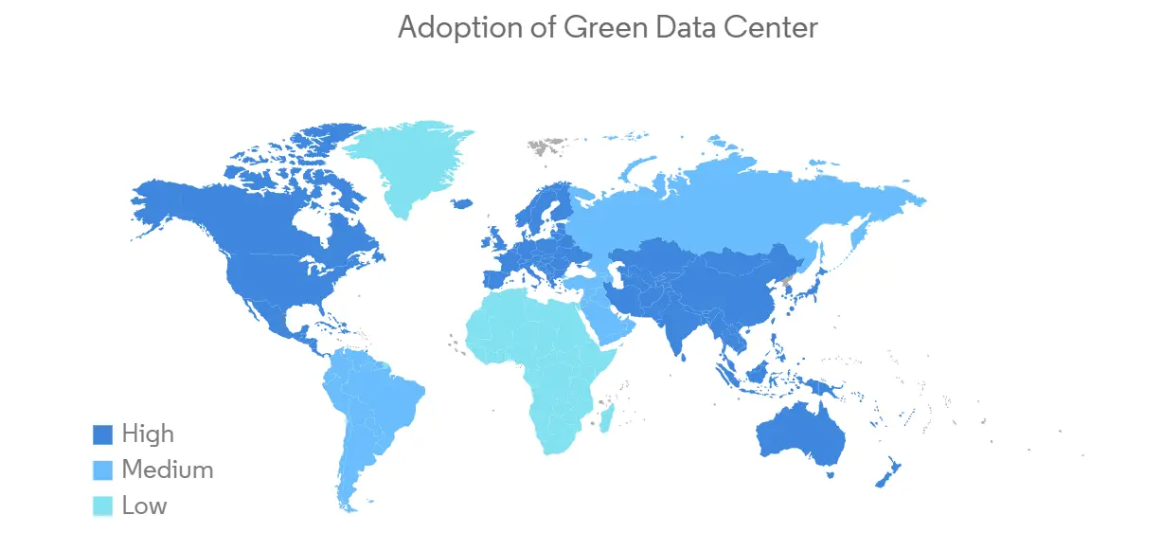
- With technological advancements and sustainability taking center stage, stakeholders in construction and real estate are presented with significant growth opportunities. Simultaneously, the Asia-Pacific facade industry is witnessing a surge in facade greening initiatives, with India and Japan at the forefront of this movement. These sustainable practices are crucial in addressing urban heat island effects and supporting eco-friendly urban planning.
- The rising green office movement further emphasizes the role of sustainable facades, with Tokyo leading the Asia-Pacific market in environmentally certified office spaces, boasting nearly 9 million square meters of green-certified office inventory. This growing focus on green facades highlights the transformative shift within the Asia-Pacific facade market, aligning with the broader sustainability goals of the region.
Facade Industry Overview
The global facade market is highly fragmented and competitive, with large companies claiming significant market share. Moreover, several key players engage in collaborations, innovations, business expansion, awards, joint ventures, and other strategies to improve their product footprint and remain competitive in the market. Furthermore, some of the major players in the market include Saint-Gobain S.A, Enclos Corp., Permasteelisa S.p., etc.
Key trends highlight a shift towards sustainable and energy-efficient facade systems. Technologies like ventilated facades and smart glass are at the forefront, enhancing thermal insulation and curbing energy use. North America, buoyed by strict green building regulations and a bustling construction scene, stands as the market leader. Meanwhile, the Asia Pacific, spurred by swift urbanization and infrastructure strides in nations like China and India, is carving out a notable growth trajectory. With governments and developers championing eco-friendly initiatives, the facade market is poised for further evolution, driven by innovation and tech integration.
Facade Market Leaders
- Saint-Gobain S.A
- Permasteelisa S.p.A
- Lindner Group
- Enclos Corp.
- AGC Glass Europe
- *Disclaimer: Major Players sorted in no particular order
Facade Market News
- January 2025: INOX Décor Pvt. Ltd., a frontrunner in kitchen and bathroom storage solutions, has teamed up with CONWOO to unveil an innovative Façade Building System at an exhibition in Siliguri.
- May 2024: In a move underscoring their joint dedication to carbon neutrality, Dow Chemical International Private Limited (commonly referred to as Dow India) inked a deal with Glass Wall Systems India. This agreement allows Dow to provide DOWSIL™ Facade Sealants, sourced from Dow’s Decarbia™ portfolio of eco-friendly solutions, specifically for Glass Wall System’s curtain wall system.
Facade Industry Segmentation
A facade is generally the front part or exterior of a building, especially an imposing or decorative one. From the engineering perspective, the facade is of great importance due to its impact on energy efficiency.
The facade market is segmented by type (ventilated, non-ventilated, and other types), material (glass, metal, plastic, fibers, stones, and other materials), application (commercial, residential, and other applications), end-user (commercial, residential, and other end-users), and geography (North America, Europe, Asia-Pacific, the Middle East, Africa, and Latin America).
The report offers market size presented in value (USD) and forecasts for the facade market for all the above segments.
| By Type | Ventilated |
| Non-Ventilated | |
| Other Types | |
| By Material | Glass |
| Metal | |
| Plastic and Fibres | |
| Stones | |
| Other Materials | |
| By End-User | Commercial |
| Residential | |
| Other End-Users | |
| By Geography | North America |
| Europe | |
| Asia-Pacific | |
| Middle East & Africa | |
| Latin America |
Facade Market Research Faqs
The Facade Market size is expected to reach USD 258.66 billion in 2025 and grow at a CAGR of 5% to reach USD 330.12 billion by 2030.
In 2025, the Facade Market size is expected to reach USD 258.66 billion.
Saint-Gobain S.A, Permasteelisa S.p.A, Lindner Group, Enclos Corp. and AGC Glass Europe are the major companies operating in the Facade Market.
North America is estimated to grow at the highest CAGR over the forecast period (2025-2030).
In 2025, the Asia-Pacific accounts for the largest market share in Facade Market.
In 2024, the Facade Market size was estimated at USD 245.73 billion. The report covers the Facade Market historical market size for years: 2019, 2020, 2021, 2022, 2023 and 2024. The report also forecasts the Facade Market size for years: 2025, 2026, 2027, 2028, 2029 and 2030.