
APAC Contract Logistics Market Size
| Study Period | 2020 – 2030 |
| Base Year For Estimation | 2024 |
| Forecast Data Period | 2025 – 2030 |
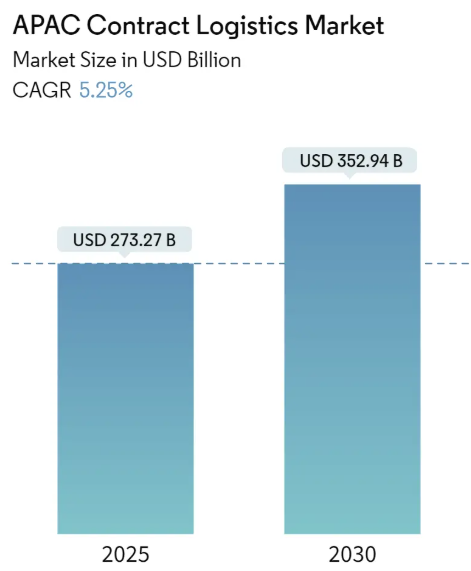
| Market Size (2025) | USD 273.27 Billion |
| Market Size (2030) | USD 352.94 Billion |
| CAGR (2025 – 2030) | 5.25 % |
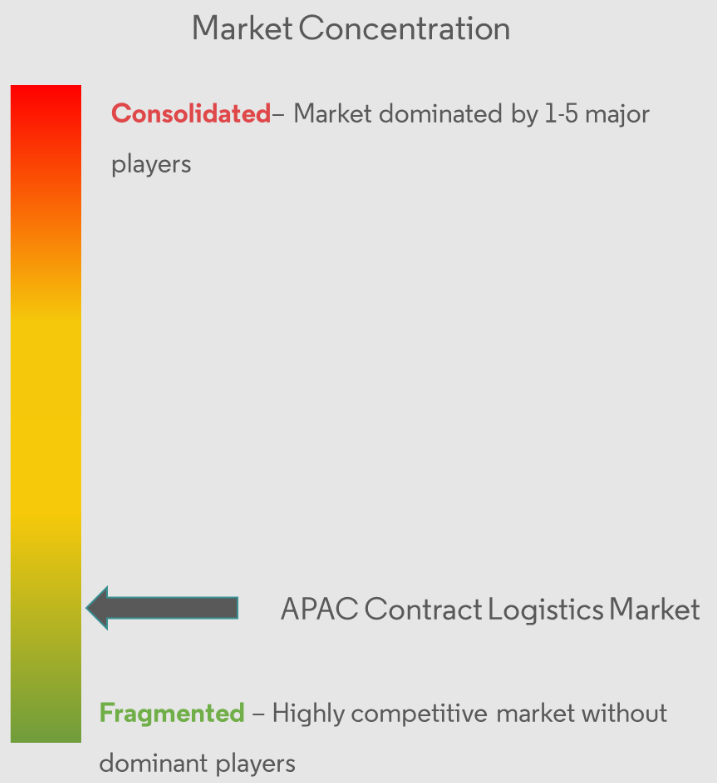
| Market Concentration | Low |
Major Players
*Disclaimer: Major Players sorted in no particular order |
APAC Contract Logistics Market Analysis
The APAC Contract Logistics Market size is estimated at USD 273.27 billion in 2025, and is expected to reach USD 352.94 billion by 2030, at a CAGR of 5.25% during the forecast period (2025-2030).
The Asia-Pacific contract logistics landscape is experiencing significant transformation driven by regional economic integration and enhanced market access. The implementation of the ASEAN-led Regional Comprehensive Economic Partnership Agreement in January 2022 has created a more unified market environment, facilitating smoother cross-border trade and logistics operations. The region’s economic resilience is particularly evident in South Asia, which demonstrated robust growth of 7.0% in 2022 before advancing to 7.4% in 2023, while East Asian economies have stabilized with a growth rate of 4.5% in 2023. This economic stability has strengthened the region’s position as a preferred destination for third-party logistics investments and operational expansion.
Infrastructure development and technological advancement are reshaping the contract logistics landscape across Asia-Pacific. China, maintaining its position as the world’s largest logistics market, generated impressive revenue of CNY 12.7 trillion (approximately USD 1.83 trillion) from its logistics industry in 2022. The region is witnessing substantial investments in smart warehousing solutions, automated material handling systems, and digital supply chain platforms. Leading logistics providers are increasingly adopting cloud-integrated logistics management software, offering real-time tracking capabilities and improved inventory management efficiency.
The industry is experiencing significant consolidation as major logistics providers expand their regional footprint through strategic acquisitions and partnerships. Companies are investing in specialized facilities and value-added services to meet the evolving needs of various industries, including the automotive, retail, and healthcare sectors. The trend toward integrated logistics solutions has led to the development of sophisticated multi-user facilities that combine warehousing, distribution, and value-added services under one roof, enabling more efficient and cost-effective operations.
Supply chain transformation initiatives are gaining momentum across the region, with a strong focus on building resilient and sustainable logistics networks. Organizations are implementing innovative solutions such as blockchain technology for enhanced transparency and artificial intelligence for optimized route planning and inventory management. The industry is witnessing increased investment in green logistics infrastructure, including electric vehicle fleets and energy-efficient warehousing facilities, as sustainability becomes a key consideration in contract logistics operations. These developments are supported by government initiatives promoting environmental responsibility and technological innovation in the logistics sector.
APAC Contract Logistics Market Trends
Growth of E-commerce Sector
Asia is at the forefront of global e-commerce, with varying adoption rates across different economies. Indonesia and Singapore lead the Southeast Asian region with approximately 30% e-commerce penetration, while countries like the Philippines, Thailand, and Vietnam show around 15% penetration as of 2022. The implementation of new trade agreements like the Regional Comprehensive Economic Partnership, combined with rising disposable incomes and increasing internet access across Asia, is supporting the region’s rapid e-commerce boom and expanding digital economy. Since the advent of digital transformation, an additional 70 million digital consumers have emerged in Southeast Asia alone, with digital transformation projected to reach a value exceeding USD 1.3 trillion in Asia by 2027.
The evolution of e-commerce across Asia Pacific has intensified competition among distributors and retailers for modern and high-quality logistics facilities. Industry projections indicate a requirement for 100-130 million square meters of additional e-commerce-dedicated logistics space over the next five years to support online sales growth in the region. Government bodies have begun implementing regulations to boost e-commerce business by providing favorable conditions. For instance, Japan’s Diet passed a new law requiring e-commerce platforms to submit annual reports to METI on their business practices, affecting major players like Google, Amazon, Facebook, Apple, and local firms Rakuten and Yahoo-Japan. In response to increased demand for contract logistics services driven by the retail e-commerce boom, logistics companies are rapidly expanding their services in the region, as evidenced by strategic acquisitions like Geodis’s purchase of Keppel Logistics to enhance its contract logistics presence and e-commerce fulfillment services in Singapore and Southeast Asia.
Demand from Automotive Sector
The Asia-Pacific region, covering 29.3 million square kilometers and home to 60% of the world’s population, has emerged as a powerhouse in the automotive sector. The region hosts some of the world’s most profitable automobile manufacturers, with China leading as the world’s largest automobile market. Chinese carmakers demonstrated remarkable growth in 2022, producing 27.02 million units, marking a 3.4% year-on-year increase, while sales rose by 2.1% to reach 26.86 million units. The electric vehicle segment has shown particularly impressive growth, with EV output in China totaling 7.1 million units in 2022, representing a 96.9% increase year-on-year, while sales of such vehicles rose by 93.4% to reach 6.89 million units.
The automotive industry’s expansion has created substantial opportunities for third-party logistics providers. Major investments in the sector include Hyundai Motor Group’s Innovation Center in Singapore, a smart manufacturing and service center in the Jurong Innovation District, which began producing electric vehicles in 2022. This facility’s logistics operations are managed by PSA Cargo Solutions, demonstrating the integral role of logistics providers in supporting automotive manufacturing. The industry’s growth is further evidenced by India’s automotive sector, which ranks as the world’s fourth-largest and is predicted to grow by 10% in 2022, driven by strong underlying demand reflecting the country’s economic expansion and consumers’ preference for personal vehicles over public transit. This growth in automotive manufacturing and sales directly translates to increased demand for sophisticated 3PL solutions, particularly in areas such as supply chain management, warehousing, and distribution services.
Segment Analysis: By Type
Insourced Segment in APAC Contract Logistics Market
The insourced segment continues to dominate the APAC Contract Logistics Market, commanding approximately 61% market share in 2024. This significant market position is driven by strategic collaborations between logistics providers and vehicle manufacturers, as well as an increase in automobile production units across the region. The segment’s strength is further reinforced by the higher quality control and operational control provided through the insourcing process. Cloud technology has emerged as one of the major technological drivers fueling the expansion of this segment, offering various advantages to transportation companies, including improved customer experience in terms of speed, reduced rates, and enhanced cargo tracking capabilities. The benefits of controlling seasonal changes of products have also contributed significantly to the segment’s dominance, as many firms encounter seasonal fluctuations in client demand and find it critical to manage such swings to preserve operational efficiency.

Outsourced Segment in APAC Contract Logistics Market
The outsourced segment is projected to grow at approximately 6% through 2024-2029, emerging as the fastest-growing segment in the APAC Contract Logistics Market. This accelerated growth is primarily driven by the advancement of contract logistics technologies and greater usage of technological devices in the region. The segment’s expansion is further supported by the APAC region’s increased concentration of OEMs and ODMs across industries, including consumer and services sectors. Rising urban population, disposable income, increasing electronic technologies activities in various countries, and the growing demand to improve quality by eliminating errors and reducing variability for better comfort while carrying and storing goods in storage places are key factors propelling this segment’s growth. The trend toward logistics outsourcing is particularly strong in emerging economies where businesses are increasingly focusing on their core competencies while leveraging specialized logistics expertise from third-party providers.
Segment Analysis: By End User
Consumer Goods and Retail Segment in APAC Contract Logistics Market
The Consumer Goods and Retail segment dominates the APAC Contract Logistics Market, commanding approximately 35% market share in 2024. This leadership position is driven by the rapid growth of e-commerce across the Asia-Pacific region, particularly in countries like China, India, and Southeast Asian nations. The segment’s strength is further reinforced by the increasing adoption of omnichannel retail strategies, sophisticated warehouse management systems, and the growing demand for efficient last-mile delivery solutions. Major retailers and e-commerce platforms are increasingly partnering with contract logistics providers to optimize their supply chain operations, enhance inventory management, and improve delivery times to meet evolving consumer expectations.
Healthcare and Pharmaceutical Segment in APAC Contract Logistics Market
The Healthcare and Pharmaceutical segment is emerging as the fastest-growing sector in the APAC Contract Logistics Market, with a projected growth rate of approximately 7% during 2024-2029. This robust growth is primarily attributed to the increasing healthcare expenditure across the region, stringent regulations requiring specialized handling and storage of pharmaceutical products, and the growing demand for temperature-controlled logistics solutions. The segment is witnessing significant investments in cold chain infrastructure, specialized warehousing facilities, and advanced tracking systems to ensure product integrity throughout the supply chain. The expansion of pharmaceutical manufacturing capabilities in countries like India, Singapore, and South Korea is further driving the demand for sophisticated healthcare logistics solutions.
Remaining Segments in APAC Contract Logistics Market
The Manufacturing and Automotive, High-Tech, and Other End Users segments collectively represent significant portions of the APAC Market, each serving distinct industrial needs. The Manufacturing and Automotive segment is characterized by complex supply chain requirements, just-in-time delivery systems, and the need for specialized handling of automotive components. The High-Tech segment focuses on the safe transportation and storage of sensitive electronic components, requiring advanced security measures and precise handling protocols. The Other End Users segment encompasses various industries, including industrial goods, energy, and construction materials, each requiring customized logistics solutions to address their unique supply chain challenges.
APAC Contract Logistics Market Geography Segment Analysis
Contract Logistics in China
China continues to dominate the Asia-Pacific contract logistics market, commanding approximately 64% of the regional market in 2024. The country’s robust manufacturing sector, particularly in the electronics and automotive industries, drives significant demand for sophisticated logistics solutions. China’s logistics infrastructure has seen remarkable advancement with the integration of automation and artificial intelligence in warehousing operations. The Belt and Road Initiative (BRI) further strengthens China’s position by enhancing connectivity and trade routes across Asia. Major logistics hubs in cities like Shanghai, Shenzhen, and Guangzhou serve as crucial nodes in both domestic and international supply chains. The country’s emphasis on technological integration, particularly in areas like smart warehousing and automated sorting systems, has revolutionized the efficiency of logistics operations. Additionally, the rapid expansion of e-commerce continues to reshape the contract logistics market, demanding more sophisticated fulfillment solutions and last-mile delivery capabilities.
Contract Logistics in Singapore
Singapore’s contract logistics market is projected to grow at approximately 9% annually from 2024 to 2029, establishing itself as the fastest-growing market in the region. The city-state’s strategic position as a global logistics hub, coupled with its advanced technological infrastructure, creates an ideal environment for APAC logistics operations. Singapore’s commitment to digital transformation and smart logistics solutions has attracted significant investments from major logistics providers. The country’s sophisticated port infrastructure, including the highly automated Tuas Mega Port, serves as a crucial transshipment hub for the entire Asia Pacific market. The government’s proactive approach in implementing advanced technologies, including blockchain and artificial intelligence in logistics operations, has significantly enhanced operational efficiency. Singapore’s focus on developing specialized logistics capabilities, particularly in high-value sectors like pharmaceuticals and electronics, has created unique value propositions for contract logistics market providers. The country’s robust regulatory framework and business-friendly environment continue to attract international logistics companies looking to establish regional headquarters.
Contract Logistics in Japan
Japan’s contract logistics market demonstrates remarkable resilience and innovation, particularly in automation and robotics integration. The country’s mature manufacturing sector, especially in automotive and electronics, continues to drive sophisticated logistics requirements. Japanese logistics providers are at the forefront of implementing advanced technologies, including automated warehousing systems and artificial intelligence-driven inventory management. The country’s aging population has accelerated the adoption of automation in logistics operations, leading to increased investment in robotics and autonomous systems. Japan’s focus on quality and precision in logistics operations has set high standards for the industry, particularly in areas like temperature-controlled logistics and specialized handling. The integration of IoT technologies in warehouse management has significantly improved operational efficiency and real-time tracking capabilities. Additionally, the country’s emphasis on sustainable logistics practices has led to innovative solutions in green transportation and eco-friendly warehousing.
Contract Logistics in India
India’s contract logistics market continues to evolve rapidly, driven by significant infrastructure developments and digital transformation initiatives. The implementation of the Goods and Services Tax (GST) has streamlined logistics operations across state boundaries, leading to more efficient supply chain networks. The country’s robust manufacturing sector, coupled with growing e-commerce activities, has created increased demand for sophisticated logistics solutions. India’s focus on developing multimodal logistics parks and modern warehousing facilities has attracted significant investments from both domestic and international players. The government’s emphasis on initiatives like ‘Make in India’ and the National Logistics Policy has created a more conducive environment for contract logistics market operations. The adoption of technology-driven solutions, including warehouse management systems and automated sorting facilities, has significantly improved operational efficiency. Additionally, the growth of specialized logistics services, particularly in sectors like pharmaceuticals and automotive, has led to the development of sector-specific expertise.
Contract Logistics in Other Countries
The contract logistics market in other Asia Pacific market countries, including South Korea, Australia, Malaysia, Indonesia, and Thailand, exhibits diverse growth patterns and unique market characteristics. These markets are characterized by varying levels of infrastructure development and technological adoption. South Korea’s advanced technological infrastructure and strong manufacturing base provide a solid foundation for APAC contract logistics market operations. Australia’s focus on efficient supply chain management and advanced warehousing solutions continues to drive market development. Southeast Asian nations like Malaysia, Indonesia, and Thailand are experiencing rapid growth in their logistics sectors, driven by increasing manufacturing activities and e-commerce expansion. These markets are witnessing significant investments in modernizing logistics infrastructure and implementing digital solutions. The growing emphasis on regional integration and cross-border trade has created new opportunities for APAC company providers across these countries. Additionally, the increasing focus on specialized logistics services and value-added offerings has led to the development of niche market segments across these regions.
APAC Contract Logistics Industry Overview
Top Companies in APAC Contract Logistics Market
The APAC contract logistics market features prominent players like DHL Supply Chain, Kuehne+Nagel, DB Schenker, CEVA Logistics, and CJ Logistics leading the industry through continuous innovation and strategic expansion. These companies are increasingly focusing on technological integration, particularly in warehouse automation, artificial intelligence, and digital platforms to enhance operational efficiency and customer experience. The market leaders are actively pursuing strategic partnerships and acquisitions to strengthen their regional presence and service capabilities, especially in emerging markets like India, Vietnam, and Indonesia. Companies are also investing heavily in developing specialized solutions for high-growth sectors such as e-commerce, healthcare, and automotive industries, while simultaneously expanding their sustainable logistics practices to meet growing environmental concerns. The competitive landscape is characterized by a strong emphasis on value-added services, end-to-end supply chain solutions, and the development of multi-modal logistics networks to provide comprehensive solutions to clients.
Fragmented Market with Strong Regional Players
The APAC contract logistics market exhibits a fragmented structure with a mix of global logistics conglomerates and strong regional specialists operating across different market segments. The market’s composition varies significantly by country, with mature markets like Singapore and Japan dominated by international players, while emerging markets like Indonesia and the Philippines feature a stronger presence of local operators. The competitive dynamics are shaped by the increasing trend of strategic alliances and joint ventures between global and local players, allowing them to combine international expertise with local market knowledge and networks.
The market is experiencing ongoing consolidation through mergers and acquisitions, particularly in key growth markets, as companies seek to expand their geographical footprint and service capabilities. Major international players are actively acquiring local companies to strengthen their presence in specific regions or to gain expertise in specialized sectors. This trend is particularly evident in e-commerce logistics, where companies are acquiring technology-driven logistics startups to enhance their digital capabilities and last-mile delivery services. The market also sees significant investment in infrastructure development and modernization of logistics facilities, creating barriers to entry for smaller players while strengthening the position of established companies.
Innovation and Sustainability Drive Future Success
Success in the APAC contract logistics market increasingly depends on companies’ ability to innovate through technology adoption and sustainable practices. Market leaders are investing in advanced warehouse management systems, robotics, and predictive analytics to improve operational efficiency and service quality. Companies are also focusing on developing specialized solutions for different industry verticals, particularly in high-growth sectors like e-commerce, healthcare, and automotive. The ability to provide customized, value-added services while maintaining cost competitiveness has become crucial for both incumbents and new entrants.
The market’s future trajectory is being shaped by increasing end-user demands for transparency, speed, and sustainability in logistics operations. Companies need to balance investment in digital transformation with maintaining competitive pricing structures, particularly in price-sensitive markets. Regulatory changes across different APAC countries, especially regarding environmental standards and cross-border trade, are creating both challenges and opportunities for market players. Success factors include the ability to build strong local partnerships, invest in sustainable practices, and develop innovative solutions that address specific market needs while maintaining operational efficiency and service quality.
APAC Contract Logistics Market Leaders
-
- Deutsche Post DHL Group (DHL Supply Chain)
- CJ Logistics
- DB Schenker
- United Parcel Services Inc.
- Nippon Express Co. Ltd
- *Disclaimer: Major Players sorted in no particular order
APAC Contract Logistics Market News
May 2023: Kuehne+Nagel opened two fulfillment centers for Elanco, an animal healthcare company, in Chengdu, West China; the new facilities include a 3000-meter square production warehouse and a 12,000-meter square distribution center for the final product, which is increasing surface and storage capacities using improved racking system.
January 2023: Both Big C Supercenter, a supermarket retailer in Thailand, and DHL Supply Chain Thailand, a provider of contract logistics, recently announced the introduction of electric trucks for product delivery, first at Big C locations in Bangkok and then at the Big C Wangnoi Delivery Center. In order to move Big C products to stores in various locations in the near future, more electric truck models are being looked into for the fleet.